


EXPLORE THE ESTATE
Discover Oakleigh
Nearly two centuries of Mobile history, told through one remarkable place.

GENERATIONS AT OAKLEIGH
Five Families. Nearly Two Centuries
Across nearly two centuries, generations of families called Oakleigh home. Each encountered a changing Mobile and left an imprint on the house, its collections, and the stories preserved here today.


THE ROPER FAMILY · 1830s–c.1850
THE IRWIN FAMILY · c.1850–1880
JAMES W. ROPER
ELIZA SIMISON ROPER
James W. Roper and his wife, Sarah Ann Davenport, were Oakleigh's first owners. After Sarah's death, Roper married Eliza Simison. The Roper family established Oakleigh during Mobile's rapid antebellum growth, beginning the story of a house that would continue to evolve for generations.
ALFRED IRWIN
MARGARET KILSHAW IRWIN
Alfred and Margaret Kilshaw Irwin made Oakleigh their home for roughly three decades. Their years at the estate spanned a transformative period in Mobile's history, including the Civil War, emancipation, and Reconstruction. The Irwins' long occupancy also left a significant mark on the house, with much of Oakleigh's present interior associated with their time here.


BEYOND THE FAMILY · 19TH CENTURY
T.K. & MARY IRWIN · 1880–1906
DAISY IRWIN CLISBY · 1906–1916
CELY GAITHER
THOMAS KILSHAW IRWIN
MARY KETCHUM IRWIN
DAISY IRWIN CLISBY
Oakleigh's story extends beyond the families who owned the estate. Enslaved people lived and worked here before emancipation, and later generations of domestic workers also shaped daily life at Oakleigh. Their experiences are essential to understanding the history of the property and the changing society around it.
Thomas Kilshaw “T.K.” Irwin inherited Oakleigh and made the house his home with his wife, Mary Ketchum Irwin. A Confederate veteran who later became prominent in Mobile's cotton trade, T.K. belonged to a generation that experienced profound changes in the city and the nation. Surviving family correspondence preserved in the Minnie Mitchell Archives provides a personal window into the Irwins' lives and their era.
Daisy Irwin Clisby, granddaughter of Alfred and Margaret Irwin and daughter of T.K. and Mary, represented the final generation of the Irwin family at Oakleigh. After more than six decades of Irwin family ownership, Daisy sold the estate in 1916, bringing one of the longest chapters in Oakleigh's history to a close and beginning its twentieth-century transition.

HERBERT COLE
Dr. Herbert Cole and his family purchased Oakleigh in 1916, beginning a new twentieth-century chapter for the estate. During the Cole years, the historic 1866 Union Barracks was relocated to the property around 1919–1920 and used as housing for African American domestic workers. The family's occupancy reflects Oakleigh's continuing evolution as both the house and grounds adapted to modern life.


THE DENNISTON FAMILY · c.1930s–1940s
HAROLD DENNISTON
LILLIAN DENNISTON
Harold and Lillian Denniston made Oakleigh their home during the middle decades of the twentieth century. Their years at the estate coincided with a period of continued change and modernization, while Oakleigh increasingly came to be recognized for its architectural and historical significance.

THE GWYNN FAMILY · 1940s–1955
SUSANNA GWYNN
Susanna Robinson Gwynn was Oakleigh's final private owner. In 1955, she sold the estate to the City of Mobile with the understanding that the historic property would be used as a museum or educational center. Her decision brought more than a century of private residence at Oakleigh to a close and opened a new chapter devoted to preservation and public history.
PRESERVING OAKLEIGH
From Private Home to Public History

In 1955, Oakleigh's long history as a private residence came to an end when Susanna Robinson Gwynn sold the property to the City of Mobile with the understanding that it would be used as a museum or educational center.
The following year, the Historic Mobile Preservation Society entered into an agreement with the City to operate Oakleigh, beginning a new chapter devoted to preservation, education, and public access.
Oakleigh was added to the National Register of Historic Places in 1971, helping secure recognition of the property's architectural and historical significance. Today, HMPS continues to preserve and interpret Oakleigh for the people of Mobile and visitors from around the world.
ARCHITECTURE & COLLECTIONS
Discover the Details
From its distinctive raised architecture to the objects preserved within its rooms, Oakleigh reveals nearly two centuries of changing tastes, technologies, and daily life. Explore the details that make the estate one of Mobile's most remarkable historic places.


ARCHITECTURE
COLLECTIONS
INTERIORS
Designed for the Gulf Coast
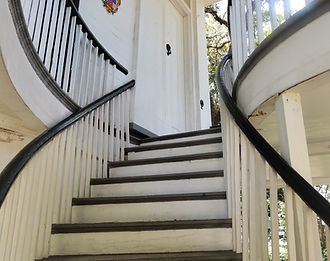
Oakleigh's raised form, sweeping staircase, broad galleries, and carefully planned spaces reflect architecture shaped by Mobile's climate, landscape, and nineteenth-century building traditions.
Objects That Tell the Story
Furniture, documents, decorative arts, paintings, and personal objects connect Oakleigh's rooms to the generations of people who lived here and to the larger story of Mobile.
Rooms Shaped by Generations